

Current Research
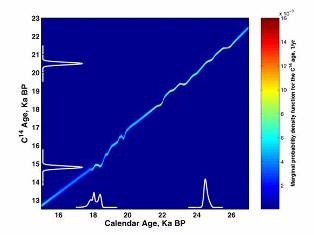 The records of the 14C content of the atmosphere and oceans contain a remarkable array of information about Earth history. Produced by cosmic rays in the upper atmosphere, 14CO2 rapidly mixes throughout the troposphere and exchanges with the reactive carbon reservoirs of the oceans and biosphere, where it decays. For the past 11,000 years, fluctuations in the atmospheric 14C have been largely produced by changes in the solar magnetic field. Many researchers believe that carbon cycle changes, tied to deep ocean circulation changes are a significant cause of atmospheric 14C fluctuations between 11,000 and 15,000 years before present (B.P.). On longer time scales, changes in the Earth’s magnetic field intensity impact the 14C content of the atmosphere, producing positive 14C anomalies during intervals of weaker geomagnetic field.
 Of practical importance to a wide range of scientific disciplines is radiocarbon calibration, which is used for converting radiocarbon years to calendar years; essential for measuring time and rates of change for numerous scientific fields. Arguably, few research topics engage so many different fields of science and have such a profound impact on our understanding of Earth and Solar science as the history of 14C in the Earth's atmosphere and the surface and deep oceans.
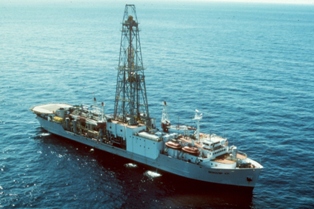 The Astronomical Theory of Climate Change relates changes in the latitudinal distribution of solar radiation, due to changes in the Earth's orbital obliquity, eccentricity, and the precession of the equinoxes, to the growth and decay of continental ice sheets. The continental records of the waxing and waning of ice sheets is very incomplete but its corollary, the rise and fall of global sea level, can be reconstructed in great detail. Sea level is considered to be one of the fundamental measures of millennial scale climate change, not only because it is a proxy of global ice volume, but also because it changes the Earth's climate boundary conditions by periodically flooding or exposing the continental shelves and opening or restricting critical passages for ocean currents. Ocean volume changes also have a direct impact on the chemistry of seawater and the atmosphere. The locations, sizes, and shapes of the continental ice sheet have a profound effect on the Earth's climate system and energy balance.
 Oxygen isotopes measurements of foraminifera skeletons are the backbone of the field of paleoceanography by variously providing a relative time scale for deep sea cores, a proxy for sea level, and a measure of paleotemperatures. Central to our use of this proxy is an understanding of the natural distribution of oxygen isotopes and their fractionation in the hydrologic cycle and in their distribution in the world's oceans. We have measured the oxygen isotope chemistry of waters throughout the world and published more seawater analyses than any other laboratory. While our initial interest in this topic began in the field of paleoceanography, we have utilized oxygen and hydrogen isotopes of the seawater molecule, combined with other ocean conservative tracers such as salinity, to decipher the processes of deep-water formation in the polar regions. Another major application of our isotope tracer laboratory is the field of coastal oceanography, where complex mixing and advection of seasonally changing source waters commonly occur.
 Early modeling studies by Peter Wyle and Clause Rooth in the 1960's indicated that small perturbations in the fresh water balance in the high North Atlantic could modulate the production of North Atlantic Deep Water and possibly effect global climate. The pioneering carbon isotope studies on benthic foraminifera by Jean-Claude Duplessy and Nick Shackleton during the 1970.s hinted that North Atlantic Deep Water production rates varied dramatically during glacial-interglacial cycles. These results fueled a gold rush of speculations that NADW may be the mystery climate amplifier of the Milankovitch cycles. This sparked thirty years of NADW studies using an evolving arsenal of deep ocean circulation proxies. The picture is still confusing today but slowly there appears to be some concordance between the newer proxies although there remain stark differences in the details.
 So much of our understanding of Cenozoic paleoceanography depends upon the chemistry and/or abundances of planktonic foraminifera species sampled from deep sea cores that we have maintained an active program on the chemistry and ecology of modern planktonic foraminifera. We are convinced that modern studies of the physical, biochemical and genetic factors that control the vertical distribution, vertical migration, skeleton formation processes, and flux of planktonic foraminifera out of the euphotic zone to the sea floor are essential for wise paleoceanographic interpretations. We began our planktonic foraminifera studies in collaboration with the late Alan Be. focused on geochemical analyses of cultured specimens of planktonic foraminifera through their life cycle.
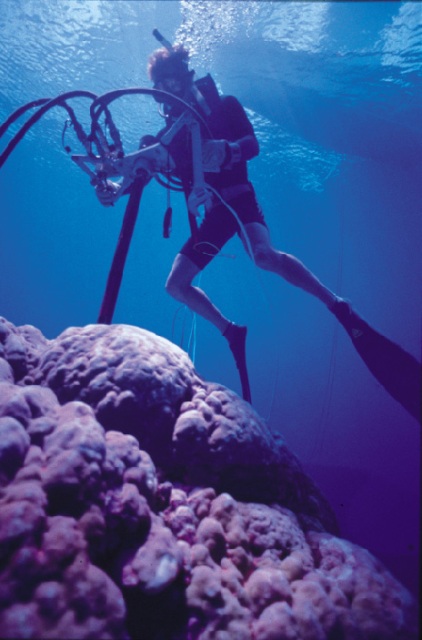
 Paleoceanographic research programs that depend upon coral chemistry measurements are growing in number and sophistication. Our applications of chemical proxies are dangerously way ahead of our knowledge of the biochemical processes that control these chemical proxies. We are vulnerable to grossly misinterpreting ocean and climate change signals of chemical time-series measured in corals and other carbonate groups such as foraminifera. The days are gone when paleoceanographers can tacitly assume that chemical measurements on skeletal archives of ocean changes can be interpreted as inorganic systems. In addition, optimum sampling strategies of ancient coral skeletons or other fossil archives require an ability to identify and properly sample suitable primary skeletal material from diagenetically altered carbonate.
Read more: Coral Biochemistry, Skeletal Chemistry and Microstructure from Culture Experiments
 While Milankovitch's astronomical cycles are the largest source of millennial-scale climate variability, El Niño and the Southern Oscillation (ENSO) is the largest source of decadal climate variability. The possible interplay between the externally forced climate signal (Milankovitch cycles) and the internal source of climate variability (ENSO) is a fascinating new area of research. In 1982/83 one of the largest El Niño climate events in history created catastrophic climate anomalies around the world, yet is was several years later that the climate community began to understand the climate connections to the sea surface temperature and sea surface salinity anomalies in the remote central Pacific Ocean.
Using the oxygen isotope and Sr/Ca thermometers measured in Barbados corals spanning the last deglaciation, we first concluded that tropical sea surface temperatures were as much as 5 degrees cooler during the last glacial period. Although we have since abandoned the Sr/Ca thermometer based on our coral culture experiments; our sea surface temperature estimates still stand based on the strength of the original oxygen isotope data. Several other proxies, including noble gas paleothermometers, tropical ice cores, and some pollen-based reconstructions, confirmed cool tropical temperatures.
