

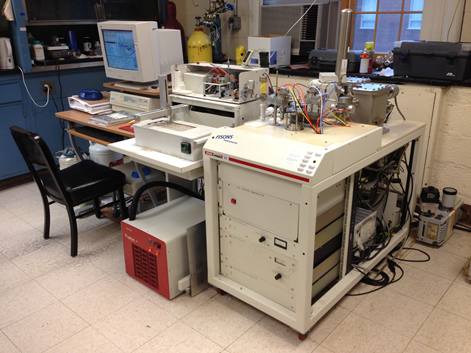
 Analytical facilities in the Stable Isotope and ICP-MS labs in the Department of Earth and Planetary Sciences include two stable isotope ratio mass spectrometers, a multi-collector ICP-MS (Thermo Scientific NEPTUNE PLUS), Quadrupole ICP-MS (Thermo Scientific ICAP Q) and Excimer Laser Ablation System. The stable isotope instruments include an Optima with a Multiprep Inlet for δ18O of water samples or δ18O and δ13C in carbonates and a GV Instruments ISOPRIME equipped with a Euro Elemental Analyzer for measuring N and C isotopes in organic materials. The NEPUTUNE PLUS has replaced our PLASMA54 ICP-MS and is used for measuring U, Th, Pa isotope abundances for coral dating by isotope dilution. The lab housing these instruments was recently renovated and equipped for strict control of temperature and humidity. Also in EPS is a Class 100 clean room used for chemical preparation of corals for Th/Pa/U dating and trace element sample preparation.
Our facilities also include the instrumentation for supporting the mass spectrometers (ovens, balances, centrifuges, laminar flow benches, etc., for preparation of standards and spikes; salinometer for water samples), high vacuum gas extraction lines, a collection of slabbing and sectioning saws dedicated to corals, several micro-drills for coral sampling. A Phillips X-ray diffractometer is available for use in the Chemistry Department for assuring that all analyzed corals are free of secondary calcite. The rock prep lab is available for the making of thin sections.
Other analytical instruments available for use in the Department of Marine and Coastal Sciences include two high-resolution double focusing ICP-MS (Element II and Element XR), SEM, and micro-mill for high resolution sampling.
Fossil Coral Collection
More than 1000 individual fossil coral samples are curated at the Rutgers Core Repository. The collection includes the R. Fairbanks wire-line drill core collection from four cruises: R/V Ranger 1988, R/V Moana Wave 1997, M/V Native Spirit 2004, and R/V Knorr 2007), outcrop samples (Barbados, Araki Island), and a number of drill cores obtained from living corals by R.G. Fairbanks and the Planetary Coral Reef Foundation.