

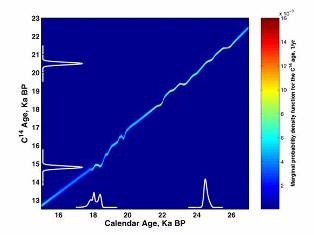
 The records of the 14C content of the atmosphere and oceans contain a remarkable array of information about Earth history. Produced by cosmic rays in the upper atmosphere, 14CO2 rapidly mixes throughout the troposphere and exchanges with the reactive carbon reservoirs of the oceans and biosphere, where it decays. For the past 11,000 years, fluctuations in the atmospheric 14C have been largely produced by changes in the solar magnetic field. Many researchers believe that carbon cycle changes, tied to deep ocean circulation changes are a significant cause of atmospheric 14C fluctuations between 11,000 and 15,000 years before present (B.P.). On longer time scales, changes in the Earth’s magnetic field intensity impact the 14C content of the atmosphere, producing positive 14C anomalies during intervals of weaker geomagnetic field.
 Of practical importance to a wide range of scientific disciplines is radiocarbon calibration, which is used for converting radiocarbon years to calendar years; essential for measuring time and rates of change for numerous scientific fields. Arguably, few research topics engage so many different fields of science and have such a profound impact on our understanding of Earth and Solar science as the history of 14C in the Earth's atmosphere and the surface and deep oceans.
| The records of the 14C content of the atmosphere and oceans contain a remarkable array of information about Earth history. Produced by cosmic rays in the upper atmosphere, 14CO2 rapidly mixes throughout the troposphere and exchanges with the reactive carbon reservoirs of the oceans and biosphere, where it decays. For the past 11,000 years, fluctuations in the atmospheric 14C have been largely produced by changes in the solar magnetic field. Many researchers believe that carbon cycle changes, tied to deep ocean circulation changes are a significant cause of atmospheric 14C fluctuations between 11,000 and 15,000 years before present (B.P.). On longer time scales, changes in the Earth’s magnetic field intensity impact the 14C content of the atmosphere, producing positive 14C anomalies during intervals of weaker geomagnetic field. | 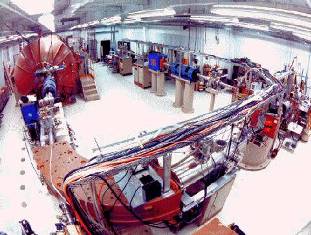     |

Of practical importance to a wide range of scientific disciplines is radiocarbon calibration, which is used for converting radiocarbon years to calendar years; essential for measuring time and rates of change for numerous scientific fields. Arguably, few research topics engage so many different fields of science and have such a profound impact on our understanding of Earth and Solar science as the history of 14C in the Earth's atmosphere and the surface and deep oceans.
Over the past 20 years we have witnessed remarkable improvements in both the development and proliferation of accelerator mass spectrometers. These instruments have reduced the counting time by a factor of 100 and reduced the sample size by a factor of 1000 compared to the classic B-counting systems. It is estimated that nearly 90% of all measurements made at the more than 50 active accelerator mass spectrometry laboratories are radiocarbon dates. This dramatic increase in the number of radiocarbon dates is driving the demand for a radiocarbon calibration program that spans the entire radiocarbon timescale from the present to 55,000 years B.P. Extension of the 14C record beyond the 0 to 13,900 year long tree ring record is well underway, being measured in many different archives, such as speleothems and deep sea sediments. In our laboratory, we have overlapped and extended the tree-ring radiocarbon calibration from 3,000 to 50,000 years B.P. using coral samples from our offshore coral reef core collections from Barbados (13.10°N; 59.32°W) in the western tropical Atlantic and Kiritimati Atoll (1.99°N, 157.78°W) in the central equatorial Pacific, and from the uplifted reefs of Araki Island (15.63°S; 166.93°E) in the western Pacific. In addition, we have reanalyzed the radiocarbon and 230Th/234U/238U age dates from our earlier radiocarbon calibration work using new pretreatment and analytical techniques and state-of-the-art Multi-collector ICP-MS instrumentation at higher precision. We have now doubled the number of coral samples passing all screening and measurement criteria presented in Fairbanks et al., (2005) and incorporated in IntCal13 (Riemer et al., 2013). The increase in data density warrants an update to our radiocarbon calibration curve that we shall provide in a forthcoming publication and on this WEB site (Mortlock et al., in prep).
In our radiocarbon calibration program (Fairbanks et al., 2005), we use paired 230Th/234U/238U (Lamont) and 14C age determinations (Lawrence Livermore National Lab, Leibniz-Labor for Radiometric Dating, Isotope Research Christian-Albrechts University Kiel, and National Ocean Sciences Accelerator Mass Spectrometry Lab) that span the entire range of the radiocarbon dating technique and present a radiocarbon calibration curve based on a Bayesian statistical model with rigorous error estimations. Due to the importance of an accurate and precise radiocarbon calibration curve, we have measured many samples in duplicate and validated the quality of the samples by dating the older samples with redundant 231Pa/235U dates. Our online radiocarbon calibration curve shall serve as a stand alone alternative to existing radiocarbon calibration curves that infer calendar ages based on interpolations and correlations of local climate proxies in deep-sea cores to the chronology of ice core proxies or assumptions about sedimentation rates. Our calibration curve has the advantage that each data point has a measured calendar age (230Th/234U/238U) and radiocarbon age with know errors that are independent of each other. In a series of published papers we present our analytical techniques in detail (Mortlock et al., 2005; Chiu et al., 2005,) and the geochemical (Cao et al., 2005) and geophysical (Chiu et al., 2006, 2007) explanations for the departure of radiocarbon dates from the true calendar ages and compare our results to other radiocarbon calibration data.
Radiocarbon Calibration data and Calibration Curves
The tree ring atmospheric radiocarbon calibration data set spanning 0 to 13,900 years B.P. is superior to all other atmospheric radiocarbon calibration data due to the number and quality of the radiocarbon measurements and the accuracy and precision of the tree dendrochronology (Stuiver et al., 1998; Reimer et al., 2013). The tree ring record now includes the 1382-ring floating tree ring data set from Kromer et al., (2004) for the time interval between 12,600 and 14,000 years B.P.
Our calibration data is compiled from more than 300 individually dated coral samples with an average resolution of one dated sample per 100 years. More than one-third of these corals overlap with the tree-ring record thus providing us with a rigorous estimate of the marine reservoir correction in each of our study areas. Our calibration extends to the limits of radiocarbon age dating to 50,000 years B.P. using the same coral sample and data quality control measures and dating techniques as applied to our younger samples and those we provided to IntCal04, IntCal09, and IntCal13.
An important difference between IntCal versus our calibration program is philosophical. Three to four years often elapse between publication of the revised IntCal and Marine curves. Between, publication and ratification of calibration curves new data sets may be added while others, determined to be problematic, are removed. These revisions can generate significant (100’s to 1000’s year) differences in calibrated ages. In contrast, doubling the number of new coral calibration data pairs has increased resolution, and hence improved accuracy and precision in converting radiocarbon years to calendar years, but has not changed the overall shape of our curve. There are sufficient calibration data such that our curve is stable and the primary improvements with future versions will be in the reduction of computed calendar year uncertainties. Hence, our expanded data set bolsters our argument that corals demonstrate the greatest potential for providing a “backbone” calibration curve beyond 20,000 years B.P. and to the limits of radiocarbon dating.
We appreciate the value of a stable internationally-ratified radiocarbon calibration curve; however, researchers want the best available calibration curve in order to make the most accurate and precise conversion of radiocarbon years to calendar years. Considering the dramatic increase in ocean, climate, and archeological research spanning the past 50,000 years, there is a high and growing demand for radiocarbon calibration. We recommend that researchers and editors always list their raw radiocarbon ages and laboratory sample identification codes and simply identify the calibration version used for their calibrated ages. This permits anyone to revise calibrated ages as calibration curves may be periodically updated. To avoid a proliferation of calibration curves using outdated versions of our calibration data, we will only offer an on-line version. To better serve the archeological community, we shall also release the calibration data and access to our curve to CalPal at the same time we update our curve.
Publications:
- [PDF] Chiu, T-C, R. G. Fairbanks, Li Cao, Richard A. Mortlock, 2007. Analysis of the atmospheric 14C record spanning the past 50,000 years derived from high-precision 230Th/234U/238U and 231Pa/235U and 14C dates on fossil corals. Quaternary Science Reviews, 26, 18-36.
- [PDF] Chiu, T-C, R.G. Fairbanks, R.A. Mortlock, L. Cao, T.W. Fairbanks, and A.L. Bloom, 2006. Redundant 230Th/234U/238U and 231Pa/235U dating of fossil corals: verification of U-series ages for radiocarbon calibration. Quaternary Science Reviews, 25, 2431-2440.
- [PDF] Fairbanks, R.G., T-C Chiu, Li Cao, Richard A. Mortlock and Alexey Kaplan, 2006. Reply to the comment by Yusuke Yokoyama and Tezer M. Esat. Quaternary Science Reviews Correspondence, 26, 3084-3087.
- [PDF] Chiu, T-C, R.G. Fairbanks, R.A. Mortlock and A.L. Bloom, 2005. Extending the radiocarbon calibration beyond 26000 years before present using fossil corals. Quaternary Science Reviews, 24, 1797-1808.
- [PDF] Fairbanks, R.G., R.A. Mortlock, T.-C. Chiu, L. Cao, A. Kaplan, T.P. Guilderson, T.W. Fairbanks and A.L. Bloom, 2005. Marine Radiocarbon Calibration Curve Spanning 10,000 to 50,000 Years B.P. Based on Paired 230Th/234U/238U and 14C Dates on Pristine Corals. Quaternary Science Reviews, 24, 1781-1796.
- [PDF] Mortlock, R.A., R.G. Fairbanks, T. Chiu, and J. Rubenstone 2005. 230Th/234U/238U and 231Pa/235U ages from a single fossil coral fragment by multi-collector magnetic-sector inductively coupled plasma mass spectrometry. Geochim. et Cosmochim. Acta, 69, 3, 649-657.
- [PDF] Hughen, KA, Baillie, MGL, Bard, E, Bayliss, A, Beck, JW, Blackwell, PG, Buck, CE, Burr, GS, Cutler, KB, Damon, PE, Edwards, RL, Fairbanks, RG, Friedrich, M, Guilderson, TP, Herring, C, Kromer, B, McCormac, FG, Manning, SW, Ramsey, CB, Reimer, PJ, Reimer, RW, Remmele, S, Southon, JR, Stuiver, M, Talamo, S, Taylor, FW, van der Plicht, J, and Weyhenmeyer, CE. 2004. Marine04 Marine radiocarbon age calibration, 0-26 cal kyr BP. Radiocarbon 46, 3, 1059-1086.
- [PDF] Reimer, PJ, Baillie, MGL, Bard, E, Bayliss, A, Beck, JW, Blackwell, PG, Buck, CE, Burr, GS, Cutler, KB, Damon, PE, Edwards, RL, Fairbanks, RG, Friedrich, M, Guilderson, TP, Herring, C, Hughen, KA, Kromer, B, McCormac, FG, Manning, SW, Ramsey, CB, Reimer, PJ, Reimer, RW, Remmele, S, Southon, JR, Stuiver, M, Talamo, S, Taylor, FW, van der Plicht, J, and Weyhenmeyer, CE. 2004. IntCal04 Terrestrial radiocarbon age calibration, 0-26 cal kyr BP. Radiocarbon 46, 3, 1029-1058.
- [PDF] Shackleton, N.J., R.G. Fairbanks, T-C Chiu, and F. Parrenin, 2004. Absolute calibration ofthe Greenland time scale: implications for Antarctic time scales and for Δ14C. Quaternary Science Reviews, 23, 1513-1522.
- Bard, E., M. Arnold, R.G. Fairbanks and B. Hamelin, 1993. 230Th/234U and 14C ages obtained by mass spectrometry on corals. In Stuiver, M., A. Long, and R.S. Kra, eds. Calibration 1993. Radiocarbon, 35, 1, 191-200.
- [PDF] Bard, E., B. Hamelin, R.G. Fairbanks, A. Zindler, 1990. Calibration of the 14C timescale over the past 30,000 years using mass spectrometric U-Th ages from Barbados corals. Nature, 345, 405-410.
- Bard, E., B. Hamelin, R.G. Fairbanks, A. Zindler, G. Mathieu, M. Arnold, 1990. U/Th and 14C ages of corals from Barbados and their use for calibrating the 14C time scale beyond 9000 years BP. Nuclear Instruments and Methods, B52, 461-468.